Speed is actually hardly just about the clock on a wall surface. On a business site, installation time equates to lane-closure licenses, crane rentals, crew overtime, sound home windows, groundwater monitoring, and also the true number that matters: times up until the superstructure or even repair service may continue. When owners talk to which body sets up a lot faster, helical piles or even steered resistance heaps, the truthful answer is, "It relies," yet certainly not in a hand-wavy way. Soil stratigraphy, gain access to, mobilization impact, and also lots profile tilt the ranges, sometimes dramatically. If your objective is shaving days, or even hrs, coming from a schedule without sacrificing capacity or compliance, you require to match up the procedure steps side by side and also in the field ailments you really have.
I have actually devoted enough time around rigs, twist monitors, and also assessors to know that headline speeds frequently hide the slow-moving components, like moving devices with an online structure or even arranging shipment of the appropriate extensions. The particulars below mirror that resided reality, certainly not a supplier's brochure.
What "speed" really means in the field
Installation speed appears in 4 areas. Initially, use: the moment to obtain crews, materials, and devices to the area where the 1st heap starts. Second, development rate: the number of heaps every switch your crew finishes in the dirt you possess, to the midsts you in fact require. Third, disruptions: evaluations, screening, noise restrictions, or wreckages that knock off. 4th, demobilization and handoff: cleaning, evidence screening documentation, as well as the minute the structure may rely on the set up system.
Helical heaps as well as steered protection piles resolve these periods in different ways. Helicals are actually torque-installed using gas travels as well as relatively tiny tools, while resistance stacks are typically driven along with a hydraulic ram responding versus the existing structure or even a short-term framework, seating factors till indicated capability is achieved through disk stress or collection. Both procedures are common in commercial foundation repair and in commercial foundation stabilization for new and also existing structures.
How helical piles enter into the ground
A helical pile utilizes one or more helical plates joined to a central ray. You rotate it into the soil, evolving the coil similar to a screw. In commercial helical pile installation, the workers typically makes use of a skid guide, mini-excavator, or even small excavator with a high-torque ride head. You track twist continuously to determine capacity. The moment you get to aim at torque at deepness, you cancel with a new-construction cap or even underpinning brace. For sidewise or uplift requirements, you might add helical anchors or even helical tieback anchors, put up in a similar way but cast and also fastened right into additional capable soil. For preserving wall structures or even cellar wall surfaces, commercial helical tieback anchor installation often join shotcrete or soldier piles.
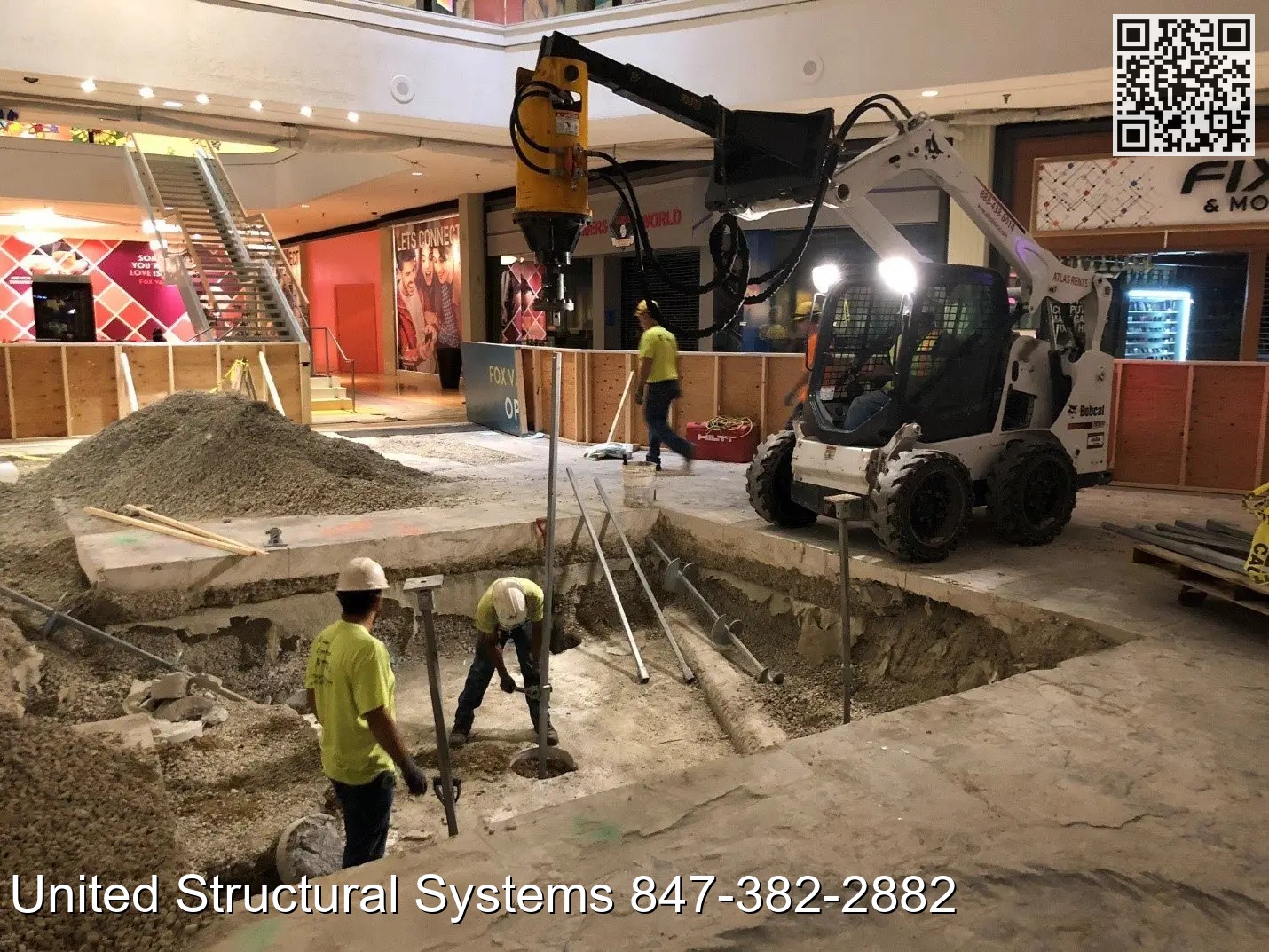
From a speed perspective, the basic conveniences is actually rotation over impact. You do not need massive impact hammers, you usually avoid pre-drilling, and you can function in tight inner parts where elevation is actually confined. On a singular switch along with decent soils, an experienced two to three person staff often specifies 8 to 20 helical piles, with outliers much higher when every thing clicks on. Quick runs under a hundred stacks find the absolute most remarkable perk due to the fact that use is mild. For deep foundation repair in energetic buildings, helicals could be installed with very little vibration, lowering coordination along with delicate tenants.
How driven protection heaps are installed
The steered resistance pile, occasionally called a push pier or protection pier, is actually a compression-only unit very most widely used for structural foundation repair. You established a bracket at the ground, after that steer steel water pipes segments along with a gas ram, utilizing the body weight of the framework as response. You drive sections till target tension is gotten to or you reached rejection. When all stacks under a footing get to the prescribed value, you can elevate if concept calls for it and secure off.
The rate of commercial resistance pile installation could be outstanding when the structure delivers really good reaction and also dirt corresponds. While mobilization might be also lighter than helicals in an underpinning situation, the development price can easily vary much more given that each pier depends upon genuine building weight and also the exact soil layer series. If you need to incorporate momentary response frames or if grounds are actually off-balance, velocity decreases. In wide-open new building and construction, protection stacks are actually much less common than helical piles or even micropiles, yet on repair projects they are actually staples considering that capacity proof is actually quick using ride pressure.
Measuring the clock: typical development ranges
Tie rate to practical varieties instead of best-case stories, and also designs show up. In silty sands or even rigorous clay-baseds with reduced clutter, a helical create may progress at around 1 to 3 mins per foot once the ride head is actually involved, not counting alignment or even coupling. Midsts of 20 to 40 feet are common in numerous office settings, which puts a single stack at 30 to 90 moments if every little thing goes smoothly. On a website with clear accessibility and also small twist requirements, a crew can commonly complete 10 to 16 helical piles in a basic day. Include hard layers, patches, or even junk fill as well as the fee can go down to 4 to 8 per day due to affix shears, re-drives, or even switching to much larger helices.
Driven resistance piles often relocate faster when the construct supplies a sturdy response. In deriving method, steering 20 to 40 feet may take 15 to forty five minutes every area, once more excluding bracket planning, which is the slow-moving component. If footings are tidy, uniform, as well as accessible, and if no short-lived shoring is actually needed, it is actually realistic to hit 6 to 12 piers daily with a tiny workers. The spread is actually large since footing prepare may double or triple opportunity if concrete demands coring or even if encouragement interferes. If you acquire a "block wall surface" at 8 feet and need to have to shift systems or even pre-drill, the whole time can easily skew.
For comparison, micropiles inhabit a third lane. Micropile installation involves punching a small dimension shaft, positioning steel, as well as grouting. Manufacturing may be consistent in really dense metropolitan websites where driven alternatives will be constricted by sound or resonance. In profits for broad relevancy, micropiles lose uncooked speed every gap. Expect 2 to 6 each day depending upon size, exploration technique, and also subsurface health conditions. On tasks where commercial micro pile installation lugs the bunch as a result of reduced headroom or even obstructions, routine certainty typically beats speed.
Mobilization as well as create time
Equipment selection sets the hue. For commercial helical pile installation, setting in motion a small excavator with a 10 to 20 1000 foot-pound travel head, torque surveillance, and a truck with pile sections is actually uncomplicated. You can easily organize within a couple of garage. For insides, you spin the ride head via dual doors, in some cases partially, and also reconstruct within. You require clearance identical to the longest area you intend to mount, often 5 to 7 feets for fractional shafts. Minimal website prep ways your first production heap can begin within hrs of arrival.
With protection piles, the lightest course exists when deriving. You need braces, hydraulic rams, hose pipes, a pump, and steel sections. You also need footing gain access to, which means digging at each boat dock site, in some cases observed reducing slabs, and cleaning the footing base. That prep stage can easily take in half the time on the first couple of locations. In beneficial situations, however, once the bracket is actually specified, steering is actually lively. The speed inquiry hinges on exactly how recurring the ground detail is. If all footings complement, setup becomes line work.
Noise, resonance, and work windows
On healthcare facilities, data centers, and occupied workplaces, noise home windows as well as vibration limits direct installation rhythm. Helical piles are silent. You listen to the hydraulic drive as well as dirt rubbing, not pound blows. This usually indicates longer ongoing work home windows and also fewer interruptions, which increases reliable velocity even if pure manufacturing costs are similar. Resistance piles generate more sound during the course of ground preparation than during the course of driving, since the gas port is actually relatively silent. In vibration-sensitive atmospheres, both bodies outperform impact-driven stacks and lots of drilling techniques, however helicals typically get fewer sound complaints.
Access and clearance constraints
In cellars, tunnel-adjacent work, or retail fit-outs, clearance kills speed. Helical bodies conform effectively along with short sections as well as right-angle travels. You may set up helical tieback anchors by means of a coring sleeve inside a limited technical area, working around ducts and also lines. Resistance stacks additionally polish in reduced clearance because sections are short and the port sits at the ground. The decider ends up being geometry: helicals require spinning allowance, protection heaps need to have bracket allowance. In my knowledge, helicals move quicker where room is actually tight however sensibly open around the heap location, while resistance stacks succeed when the footing is the only available surface and also you can dig deep into straight under it.
Soil disorders that hasten or even delay each method
Soil directs development, capability connection, and also team well-being. Helical piles love consistent, delicate grounds and tense clay-baseds. They despise big cobbles, caught construction particles, and also quite soft natural coatings where torque climbs however overlays perform certainly not "bite" effectively. Pre-drilling is an alternative however counteracts some speed conveniences. In sands with higher groundwater, twist connection continues to be sound, and the procedure remains tidy contrasted to slurry drilling.
Resistance piles prefer profiles where end bearing or rubbing creates progressively and the property delivers sufficient response to steer to design stress. They strain in extremely light properties where you can easily certainly not create sufficient response to innovation piles. In those situations, a brief response structure incorporates price as well as opportunity. They likewise slow down when you experience varying levels under adjoining brackets, due to the fact that every site develops into its personal investigation.
Micropiles deal with most unfavorable ground but at the price of rate. If your site consists of junk stuffing or even karst spaces, micropiles supply assurance through boring and also grouting via it, which can maintain a routine that would certainly typically be uncertain along with driven systems.
Quality control as well as evidence of capacity
Helicals deliver torque-to-capacity correlation. Most developers use well established partnerships along with site-specific calibration if needed. Torque helical pier systems monitoring is ongoing, logged, as well as basic to evaluate. Coming from a velocity standpoint, that implies capability proof occurs in the course of innovation, and you perform certainly not wait for cement to treat or even cyndrical tubes to get there. For commercial foundation stabilization under time stress, that is actually a major plus.
Resistance heaps verify ability through drive stress and set, which the inspector can witness and also visit real time. Verification and airlift often occur the very same day, speeding structural foundation repair. The pause comes when footing irregularity or eccentric tons need re-checks or even additional stacks, which you find one bracket at a time. Helicals have a tendency to disclose problems previously through twist trends.
Micropiles need grout treatment as well as, if pointed out, lots tests that happen after a hanging around time period. On lengthy schedules or even multi-phase building and construction, that is actually manageable. On an emergency situation commercial foundation repair where a column needs to have to be back internet tomorrow, micropiles seldom compete on speed.
Case illustrations that disclose the trade-offs
An office build-out in a midtown tower had to substitute a line of pillars along with a transactions shaft, needing brand-new deeper assistances in a garage along with 9-foot clearance as well as strict sound limitations. Helical piles got to 35 feet through fill in to dense sand. Two operators and also a laborer put up 12 stacks over two times, featuring layout, torque surveillance, and caps. A driven alternative will require pre-drilling with flooring shafts to gain response or even short-term structures, including a time or two.
A big-box retail settlement repair used resistance stacks due to the fact that the piece as well as footings came and even. Footing bottoms were well-maintained, the framework held excellent body weight, and also ground was a predictable silty clay. Two teams averaged 10 to 14 piers per day, elevating areas as they went, and considered places to floor professionals in sequence. Helicals would have functioned, but bracket prepare was the pacing product regardless, as well as resistance piles possessed lesser equipment price every location.
A light creating facility on really soft tellurian soils preferred helical piles for brand-new tools pads. The property's weight would certainly not have offered ample reaction for resistance heaps in the course of setup, and also temporary frames would have reduced things down. Helicals got to style torque at 42 feets with 8-inch as well as 10-inch layers, and the crew kept a stable rhythm, 9 to 11 heaps per day every rig, in spite of minor twist stalls around stashed debris.
Tiebacks and supports: schedule make use of on lateral work
For maintaining designs and basement wall surfaces, helical tieback anchors accelerate routines given that you may evaluate them promptly to design load and transfer to the following area. No grout cure, very little clutter. On a shotcrete soldier pile wall surface along a residential or commercial property line, our experts raised tiebacks at 15 to 25 mins each in channel dense sands, evaluated instantly, and cut to duration. Conventional grouted tieback anchors would have forced a multi-day lag between rotary tool, cement, as well as exam, crowding the wall along with professions and slowing rebar as well as shotcrete crews.
That stated, if geology is fractured stone or even extremely changeable, grouted tiebacks may outmatch helicals merely by piercing with the problem layers with confidence. As constantly, speed adheres to predictability.
Logistics that gently determine outcomes
Crews shed velocity at combinings and in staging. With helicals, organize your expansion mix to minimize junctions: way too many brief sticks save clearance but melt time. Always keep a tidy laydown, source of power within hose span, and also spare pins on stand by. Keep an eye on twist calibration, since a lifeless transducer quits a job quicker than anything.
Resistance stack crews obtain opportunity by systematizing brace prep. Saws as well as cracking weapons organized per location, layouts for screw gaps, and also pre-cut shims make the distinction between thirty minutes and also 90 mins. If you require to relocate spoil or even function in narrow troughs, timetable a devoted worker to maintain the stack lead clear so the port driver certainly never waits.
For commercial helical pile installation and commercial resistance pile installation in metropolitan websites, distributions should sync with the job face. Twenty minutes waiting on a forklift five opportunities a day removes the academic rate advantage of any kind of system.
Where expense converges along with speed
Projects seldom purchase speed alone. If components for helicals set you back much more than press boat docks, or even the other way around, a schedule win should offset bucks. The fastest set up can lose to a slightly slower method if team size is actually leaner or even if you may function 2 much smaller gears in parallel rather than one bigger system along with an idle 2nd crew. Micropiles, although slower every location, might allow night job when noisy alternatives are banned, and that can easily press calendar days sufficient to win.
The right metric is typically stacks every crew-day per buck of all-in cost. Helicals excel at modest counts along with tough access. Protection piles succeed at repetitive reinforcement on bigger establishments. Micropiles succeed at complicated geography or very tight corridors with expected, if slower, progress.
Foundation gap repair as well as the clock
Crack repair in commercial setups frequently couple with deeper elements. If a wall structure shows stair-step splits tied to settlement deal, your routine depends on maintaining movement prior to epoxy shot or carbon dioxide fiber work. Helical piles under trouble grounds can prevent movement quickly, and also helical tiebacks can ease lateral tons responsible for a bowing wall structure to ensure that gap fixings keep. Resistance stacks may do the very same in squeezing regions. The setup method you select governs when you may carefully infuse, spot, and also reopen the room. A day or 2 minimized deep foundation repair commonly conserves a full week of follow-on business, which is why superintendents consume over the stack calendar.
Practical assistance for picking speed on your project
- If space is restricted, noise is restricted, and soil is reasonably consistent, helicals often provide the quickest pathway to ability along with marginal disruption. If you are actually deriving bigger business footings along with good get access to as well as consistent particulars, protection stacks typically surpass helicals the moment footing prep is streamlined. If geography is actually hostile to driven devices or gain access to is actually extreme, micropiles might move slower per gap but maintain the schedule foreseeable as well as teams productive. For lateral or even uplift necessities against cramping timetables, helical anchors and helical tieback anchors steer clear of cement remedy and enable prompt evidence testing. When a design is actually as well lightweight to respond for protection stacks, expect delays from brief frameworks. Helicals bypass that, which frequently creates them a lot faster regardless of similar per-pile times.
A better examine staff make-up and also productivity
On a common helical team, you have an operator on the bulldozer or even skid, a top for positioning and also torque tracking, and a worker taking care of extensions as well as pins. With really good rhythm, the driver never ever leaves behind the commands. The twist lead places centerline as well as examinations plumb, and the worker feeds the upcoming piece. Whenever the operator walk out to assist with couplings, creation drops. Small tweaks, like pre-lubed bolts as well as a shade board for wrenches, always keep activity fluid.
For protection piles, the bracket crew performs the hefty hauling. The operator handles excavation and also footing preparation. The port driver and also a 2nd worker ride portions, keep track of stress, and also weld or even pin joints as needed to have. Because each site possesses its personal mini-sequence, instruction for repeatable brace create and also consistent bearing surface coating is actually the biggest bar on velocity. Workers that photograph and also file each bracket just before driving catch mistakes early as well as avoid modify that burns half-days.
Documentation and turn over without dropping time
Inspectors appreciate files more than your stop-watch, as well as truly thus. For helical piles, clean twist logs along with deepness versus twist charts, stack i.d., as well as firing details let the designer validate the very same day. For resistance heaps, disk stress logs every assist, bracket IDs, and lift reports assist recognition. Build layouts for both. When commercial foundation repair consists of lots of internal heaps inside an operating center, documents delays can easily delay follow-on trades regardless of whether the heaps went in fast.
The duty of style choices in field speed
Design is actually certainly not neutral to speed. A helical layout that uses a somewhat bigger helix to reduce deepness by 10 feet may spare a time around lots of piles. A resistance boat dock layout that combines places in to balanced groups can easily cut airlift cycles and also lower the variety of uses. On micropiles, opting for a casing via the best junk area prevents stuck rods and shed tooling, always keeping boring constant. Designers and service providers that collaborate early can trade little product boosts for big routine gains.
Where the 2 bodies meet in combination solutions
Plenty of industrial jobs benefit from combining devices. Helicals can easily take care of indoor pillars where get access to is actually precarious, while resistance heaps sustain perimeter footings along with better excavation get access to. Helical tiebacks can manage sidewise tons on a wall while micropiles take vertical bunches at the same soldier piles. The fastest overall routine in some cases originates from using each resource where it runs better, as opposed to obliging one approach to do everything.
Bottom line for schedulers and owners
If installment speed is actually the top priority, helical piles normally bait projects along with restricted access, rigorous sound limitations, or variable job windows. Resistance stacks typically lead on recurring groundwork under bigger industrial structures where bracket prep may be standardized. Micropiles provide schedule assurance in hard ground at the cost of slower per-hole times. For many commercial foundation stabilization jobs, the fastest coating sets helicals for upright lots along with helical tieback anchors for sidewise control, handing off to fracture repair work and superstructure job without a cure delay.
The smartest method is to mock up 1 or 2 sites early. Track actual minutes for each and every step, certainly not only the exploration or driving. helical pile foundations Measure bracket prepare, combining opportunity, verification, and also clean-up. Use that information to predict your crew-day matter. Along with truthful numbers, the choice in between a helical pile and a resistance pile becomes clear, and the times you save are going to show up certainly not just in the pile log however in the important pathway that matters to everybody on site.
 Ask ChatGPT
 Ask Grok
 Ask Perplexity
 Ask Claude
 Ask Google AI
 Ask You